

Your AI is only as good as what it knows. Give it graduate-level knowledge in six business disciplines.
The Executive Curriculum: six libraries, 180 lessons, from foundations to capstone in Strategy, Market, Finance, Operations, Technology and People.
What a real curriculum changes
-

Answers you can trust.
Without a curriculum, your AI answers from whatever it finds. With one, every answer is built on the same proven frameworks and names the lesson it came from. Ask the same question twice, or from two desks, and you get the same answer.
-

Agents that share one grounding.
Give each agent the libraries its job needs: Market and Strategy for sales, Finance for planning, People for onboarding. Each one starts with graduate-level knowledge, and because they all learn from the same curriculum, your sales agent and your finance agent won’t contradict each other.
-

One standard of knowledge, company-wide.
Your AI teaches every employee the same lessons, in the same terms, at their own pace. Teams speak one business language, and every manager gets the thinking once reserved for executives.
And once you have it, it can teach every employee.
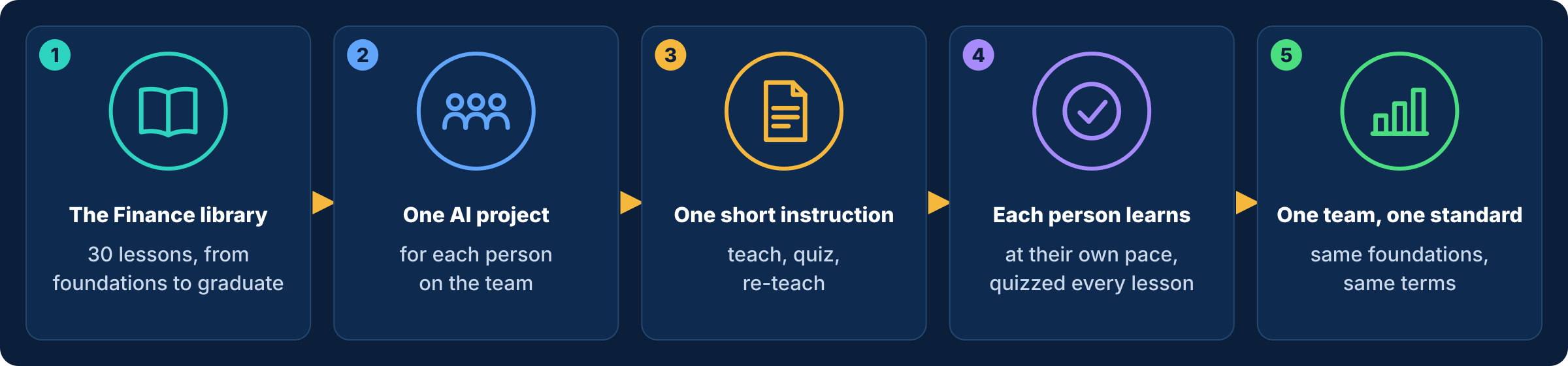
The same libraries that ground your AI can also train your people. Take your finance department. Create one AI project for each person on the team. Add the Finance library and the short instruction below. That is the whole setup.
Each person is then taught all 30 finance lessons, from reading financial statements to valuation and capital allocation, at the speed they can absorb it. The AI explains each concept, checks understanding, quizzes them at the end of every lesson and re-teaches anything they miss before moving on.
Within weeks, everyone on the team has learned the same foundations, uses the same terms and applies the same frameworks. Training like this has never been available to an entire department at this price.
The entire instruction
“You are a personal tutor for one employee, teaching the Finance library of the Executive Curriculum. Teach the 30 lessons in order, starting with F101. Present one section at a time in plain language, use the lesson’s own tables and examples, and check that I understand before moving on. Adjust the pace to me: go deeper when I struggle and faster when I’m ready. At the end of each lesson, give me a five-question quiz drawn only from that lesson. If I miss a question, re-teach that concept and quiz me on it again. Teach only from the curriculum, and name the lesson and section behind each explanation. At the start of each session, ask which lesson I finished last and continue from there.”
The instruction is the easy part. A complete, authoritative curriculum for the AI to teach from is the hard part. That is what you are getting.
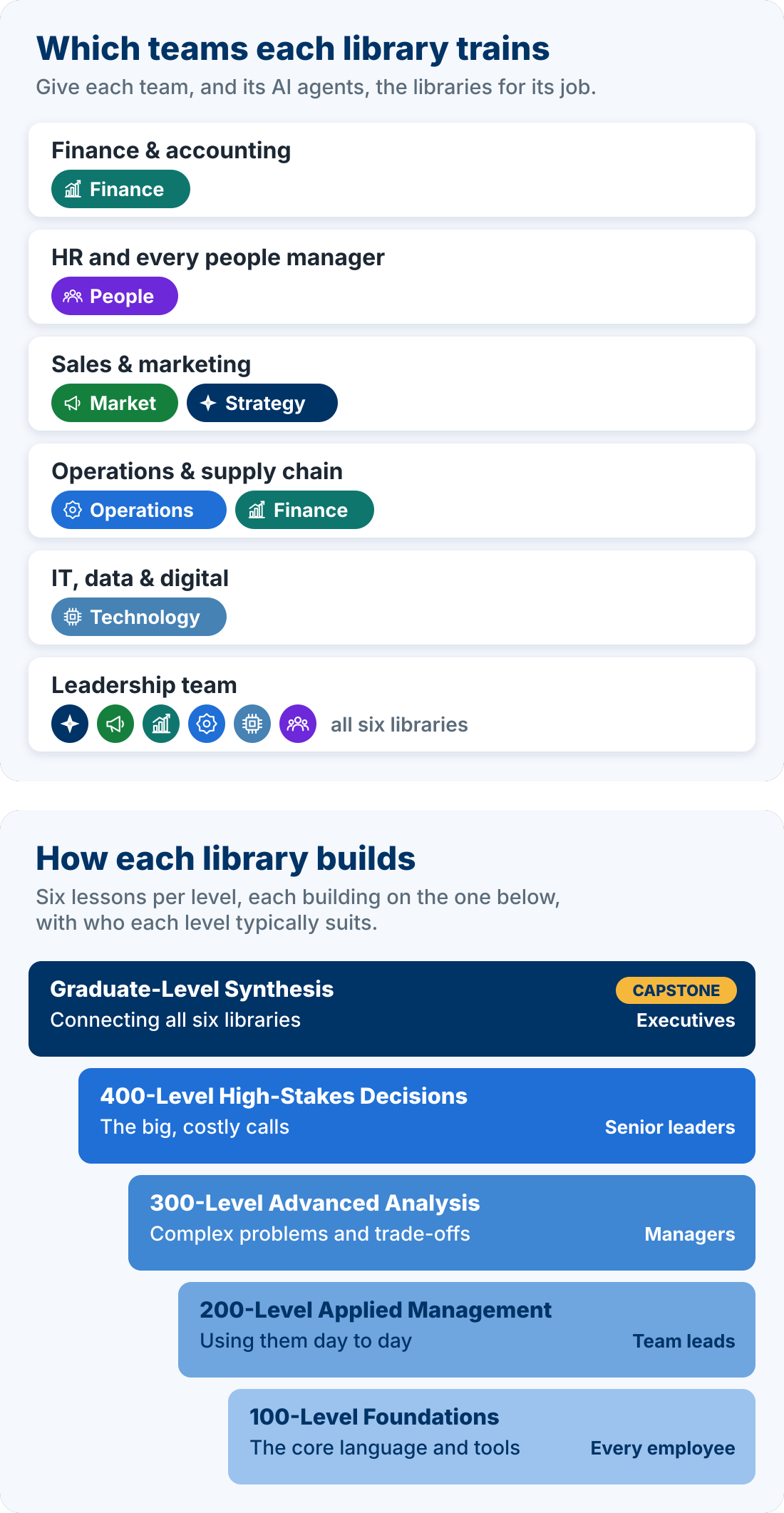
The same works for every team with a matching library: People for HR and every manager, Market and Strategy for sales and marketing, Operations for operations and supply chain, Technology for IT, and all six for your leadership team.
Six libraries. 180 lessons. From 101 foundations to the 506 capstone.
-

Strategy
Value creation, competitive advantage and the choices that shape long-term success.
30 lessons · 276 concepts · S101 to S506 capstone
Competitive Advantage & Positioning
Business Models & Growth
Scenario Planning & Decision Quality
Mergers, Acquisitions & Transformation
Governance, Risk & Execution
-

Market
How markets and customers behave, and how to price, position and grow.
30 lessons · 262 concepts · M101 to M506 capstone
Market Sizing & Segmentation
Buyer Behavior & Customer Economics
Pricing & Revenue Architecture
Go-to-Market, Brand & Positioning
Competitive Intelligence & Forecasting
-

Finance
How the money works, from the financial statements to valuation and capital allocation.
30 lessons · 277 concepts · F101 to F506 capstone
Financial Statements & Cash Flow
Budgeting, Forecasting & Modeling
Investment Decisions & Valuation
Capital Allocation & Financing
Risk, M&A & Restructuring
-

Operations
How work gets done reliably and efficiently, from process flow to global supply chains.
30 lessons · 288 concepts · O101 to O506 capstone
Process Flow, Capacity & Constraints
Quality & Lean Improvement
Supply Chains & Procurement
Forecasting, S&OP & Planning
Resilience & Automation
-

Technology
How technology creates value safely, from architecture and data to AI governance.
30 lessons · 383 concepts · T101 to T506 capstone
Enterprise Architecture & Data
Cybersecurity & Resilience
Cloud, Platforms & Integration
Technology Economics & Sourcing
AI Strategy & Governance
-

People
How organizations and people perform, from design and hiring to culture and change.
30 lessons · 426 concepts · P101 to P506 capstone
Organization Design & Decision Rights
Hiring, Performance & Rewards
Leadership & Succession
Culture, Change & Engagement
People Analytics & AI Workforce Change
Every lesson, library by library
This is the full curriculum available today: six libraries, thirty lessons each. Open any library to see its lessons in order, from 100-level foundations to the graduate-level capstone.
-
30 data tables · 30 diagrams · S101 to the S506 capstone
100-Level Foundations
S101 Strategy Fundamentals and the Logic of Value Creation
S102 Industry Structure and Competitive Analysis
S103 Competitive Advantage and Positioning
S104 Business Models and Value Capture
S105 Strategic Objectives, Metrics, and Governance
S106 Stakeholders, Purpose, and Strategic Boundaries
200-Level Applied Management
S201 Resources, Capabilities, and Core Competence
S202 Growth Strategy and Adjacency Expansion
S203 Corporate Strategy and Portfolio Management
S204 Strategic Horizons and Option Portfolios
S205 Scenario Planning and Strategic Foresight
S206 Strategic Decision Quality and Bias Control
300-Level Advanced Analysis
S301 Competitive Dynamics and Strategic Interaction
S302 Innovation, Disruption, and Strategic Renewal
S303 Platforms, Networks, and Ecosystem Strategy
S304 Global Strategy and Geographic Expansion
S305 Alliances, Partnerships, and Ecosystem Governance
S306 Strategy Execution and Alignment
400-Level High-Stakes Decisions
S401 Mergers, Acquisitions, and Corporate Development Strategy
S402 Transformation and Turnaround Strategy
S403 Strategic Risk, Resilience, and Optionality
S404 Governance, Boards, and Strategic Control
S405 Resource Allocation as Strategy
S406 Strategy Under Deep Uncertainty
Graduate-Level Synthesis
S501 Dynamic Capabilities and Organizational Adaptation
S502 Systems Strategy and Complex Adaptive Organizations
S503 Geopolitics, Institutions, and Nonmarket Strategy
S504 AI, Technology, and Business Model Strategy
S505 Strategic Case Synthesis and Pattern Recognition
S506 Integrated Strategic Synthesis for Enterprise Decisions
-
30 data tables · 30 diagrams · M101 to the M506 capstone
100-Level Foundations
M101 Market Definition, Boundaries, and Market Sizing
M102 Customer Segmentation and Needs Analysis
M103 Buyer and Consumer Behavior
M104 Competitive Landscape and Position Mapping
M105 Demand, Supply, and Market Equilibrium
M106 Market Lifecycle and Category Evolution
200-Level Applied Management
M201 Market Research Design and Evidence Quality
M202 Pricing Fundamentals and Value-Based Pricing
M203 Go-to-Market Strategy and Channel Design
M204 Brand, Positioning, and Market Messaging
M205 Customer Economics and Lifetime Value
M206 Product-Market Fit and Adoption Dynamics
300-Level Advanced Analysis
M301 Competitive Intelligence Systems
M302 Industry Structure, Profit Pools, and Value Chains
M303 Macroeconomics, Business Cycles, and Market Demand
M304 Regulation, Public Policy, and Market Structure
M305 B2B Markets and Complex Buying Systems
M306 International Market Entry and Localization
400-Level High-Stakes Decisions
M401 Market Forecasting and Demand Modeling
M402 Advanced Pricing and Revenue Architecture
M403 Platforms, Ecosystems, and Network Markets
M404 Behavioral Economics for Executive Market Decisions
M405 Category Creation, Repositioning, and Market Shaping
M406 Reputation, Trust, and Market Response in Crisis
Graduate-Level Synthesis
M501 Causal Inference and Experimentation for Market Decisions
M502 AI-Enabled Market Analytics and Synthetic Insight
M503 Geopolitical and Regulatory Scenario Analysis
M504 Weak Signals, Trend Detection, and Horizon Scanning
M505 Market Entry and Competitive Response Case Synthesis
M506 Integrated Market Synthesis for Enterprise Decisions
-
40 data tables · 26 diagrams · F101 to the F506 capstone
100-Level Foundations
F101 Financial Statements and the Economic Story of the Business
F102 Cash Flow, Liquidity, and Financial Resilience
F103 Cost Structure, Margins, and Unit Economics
F104 Budgeting, Forecasting, and Management Planning
F105 Working Capital and the Cash Conversion Cycle
F106 Time Value of Money and Discounted Cash Flow Foundations
200-Level Applied Management
F201 Capital Budgeting and Investment Evaluation
F202 Cost of Capital, Capital Structure, and Financing Policy
F203 Financial Performance Analysis and ROIC
F204 Scenario, Sensitivity, and Break-Even Analysis
F205 Integrated Financial Modeling and Driver-Based Forecasts
F206 Treasury, Banking, and Short-Term Funding
300-Level Advanced Analysis
F301 Enterprise Valuation and Value Drivers
F302 Capital Allocation and Portfolio Economics
F303 Financial Risk Management
F304 Credit, Debt Capacity, and Covenant Analysis
F305 Mergers and Acquisitions Economics
F306 Pricing, Revenue, and Growth Economics
400-Level High-Stakes Decisions
F401 Advanced Corporate Finance and Real Options
F402 Restructuring, Distress, and Turnaround Finance
F403 International Finance, Currency, and Cross-Border Exposure
F404 Derivatives and Hedging for Corporate Risk
F405 Private Capital, Venture, and Alternative Financing
F406 Investor Relations, Signaling, and Capital Markets Communication
Graduate-Level Synthesis
F501 Corporate Governance, Incentives, and Financial Agency Problems
F502 Macroeconomic Regimes and Corporate Financial Strategy
F503 Financial Analytics, AI, and Decision Systems
F504 Acquisition Integration, Synergy Realization, and Deal Postmortems
F505 Strategic Finance Case Synthesis
F506 Integrated Strategic Finance for Enterprise Decisions
-
67 data tables · 30 diagrams · O101 to the O506 capstone
100-Level Foundations
O101 Operating Systems, Processes, and Flow
O102 Capacity, Bottlenecks, and Constraint Management
O103 Quality Management and Continuous Improvement
O104 Inventory and Materials Fundamentals
O105 Planning, Scheduling, and Throughput Control
O106 Service Operations and Customer Experience Delivery
200-Level Applied Management
O201 Supply Chain Fundamentals and Coordination
O202 Forecasting, S&OP, and Demand-Supply Alignment
O203 Lean Systems and Waste Reduction
O204 Cost, Productivity, and Operating Leverage
O205 Reliability, Maintenance, and Asset Effectiveness
O206 Project and Program Operations
300-Level Advanced Analysis
O301 Operations Strategy and Competitive Capability
O302 Supply Network Design and Footprint Strategy
O303 Procurement, Supplier Strategy, and Contracting
O304 Revenue Management and Capacity Economics
O305 Product Development and Launch Operations
O306 Operations Analytics and Optimization
400-Level High-Stakes Decisions
O401 Operational Risk, Resilience, and Business Continuity
O402 Global Supply Chains and Geopolitical Exposure
O403 Sustainable Operations and Resource Efficiency
O404 Digital Operations, Automation, and Industry 4.0
O405 Scaling Operations and Operating Model Evolution
O406 Advanced Constraint and Variability Management
Graduate-Level Synthesis
O501 Systems Thinking for Complex Operations
O502 Enterprise Operating Model Transformation
O503 AI-Augmented Operations and Autonomous Workflows
O504 Complex Service-System Design
O505 Operational Stress Testing and Scenario Exercises
O506 Integrated Operations Synthesis for Enterprise Decisions
-
60 data tables · 30 diagrams · T101 to the T506 capstone
100-Level Foundations
T101 Enterprise Technology Landscape for Executives
T102 Enterprise Architecture and Systems Thinking
T103 Data Foundations, Information Models, and Data Quality
T104 Cybersecurity Fundamentals and Risk Language
T105 Cloud, Platforms, and Modern Infrastructure
T106 Software Delivery and the Technology Lifecycle
200-Level Applied Management
T201 Enterprise Applications, ERP, CRM, and Core Systems
T202 Integration, APIs, Identity, and Interoperability
T203 Data Governance, Privacy, and Information Stewardship
T204 Technology Portfolio, Vendor, and Sourcing Management
T205 Technology Economics, TCO, and FinOps
T206 Technology Service Management and Reliability
300-Level Advanced Analysis
T301 Digital Transformation Strategy and Value Realization
T302 AI and Machine Learning Foundations for Executives
T303 Analytics, Decision Systems, and Data Products
T304 Technology Risk, Resilience, and Disaster Recovery
T305 Digital Product and Platform Management
T306 Technical Debt, Legacy Modernization, and Architecture Evolution
400-Level High-Stakes Decisions
T401 Cybersecurity Strategy, Governance, and Executive Oversight
T402 Cloud, Edge, IoT, and Distributed Technology Strategy
T403 Emerging Technology Evaluation and Adoption
T404 Build, Buy, Partner, and Platform Choice
T405 Technology Operating Models and Product-Centric Organizations
T406 Technology Due Diligence and M&A Integration
Graduate-Level Synthesis
T501 Enterprise AI Strategy and Governance
T502 Agentic Systems, Automation, and Human-AI Work Design
T503 Data and AI Platform Architecture
T504 Technology-Driven Business Model Innovation
T505 Future Technology Scenarios and Strategic Foresight
T506 Integrated Technology Synthesis for Enterprise Decisions
-
60 data tables · 30 diagrams · P101 to the P506 capstone
100-Level Foundations
P101 Organizational Behavior and Human Performance
P102 Organization Design and Decision Rights
P103 Workforce Planning and Capacity
P104 Performance Management and Accountability
P105 Compensation, Rewards, and Incentive Foundations
P106 Employment, Labor, and Workforce Governance Foundations
200-Level Applied Management
P201 Talent Acquisition and Selection Systems
P202 Learning, Capability Building, and Leadership Development
P203 Succession Planning and Leadership Continuity
P204 Leadership Fundamentals and Executive Effectiveness
P205 Culture, Norms, and Organizational Climate
P206 Engagement, Retention, and Employee Experience
300-Level Advanced Analysis
P301 People Analytics and Workforce Evidence
P302 Team Design, Collaboration, and Network Effectiveness
P303 Power, Politics, Influence, and Informal Organization
P304 Negotiation, Conflict, and Difficult Conversations
P305 Change Management and Organizational Adoption
P306 Inclusion, Fairness, and Workforce Decision Quality
400-Level High-Stakes Decisions
P401 Executive Compensation and Incentive Governance
P402 Labor Relations, Collective Bargaining, and Workforce Negotiation
P403 Global Workforce and Cross-Cultural Management
P404 Hybrid Work, Digital Work, and Organizational Technology
P405 Organizational Transformation and Workforce Restructuring
P406 Strategic Human Resource Management
Graduate-Level Synthesis
P501 Human Capital Strategy and Enterprise Value
P502 Organizational Network Analysis and Social Capital
P503 AI, Automation, and Workforce Transformation
P504 Crisis Leadership, Trust, and Organizational Resilience
P505 Leadership and Organization Case Synthesis
P506 Integrated People Synthesis for Enterprise Decisions
Written so your AI reads it accurately
180 lessons · 1,900+ concepts · 287 data tables · 176 diagrams · all in Microsoft Word
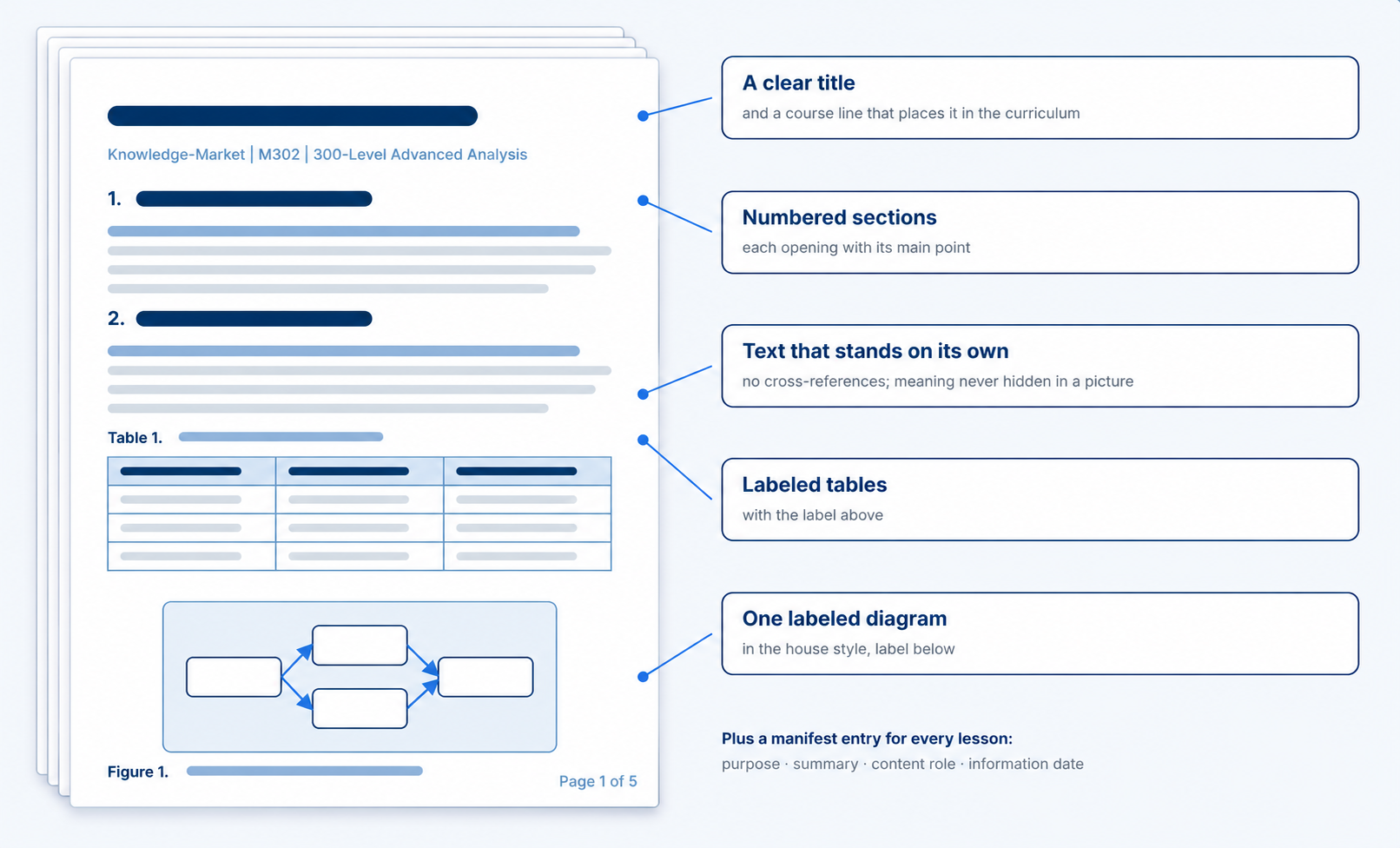
One concept per section, main point first. The AI retrieves complete ideas, not fragments, and your people can skim to the point.
Nothing hidden in pictures. Every table is labeled and every diagram’s meaning is stated in the text, so AI tools that can’t read images still get the full content.
A map for the AI. A Foundations guide explains how the libraries, levels and lesson codes fit together, and a metadata manifest summarizes all 180 lessons so the AI can find the right source fast.
Ready for Microsoft 365 agents. A Copilot Studio instruction template shows an agent how to use the structure well.
Practical, not academic. Many of the data tables are decision frameworks and common failure patterns executives can use the same day.
Designed by Jack Frost Design, modeled on sixteen published programs at leading business schools and professional bodies, written with AI assistance and reviewed by people, lesson by lesson. Tested in three live deployments.
Ready today. Built to grow.
A foundation for your own knowledge. The kit includes a Copilot prompt for Microsoft Word, the document standard every lesson follows, prompts for writing metadata summaries, and sample Initiative and Research documents. Add your own policies, playbooks and research in the same structure, and your AI treats them with the same precision as the curriculum.
Works with any AI. The lessons are Word documents, so they work with Microsoft 365 Copilot, ChatGPT, Claude, NotebookLM or a system of your own, and they move with you if you change platforms. In Microsoft 365, the libraries can serve as SharePoint knowledge sources for Copilot agents. Setup and retrieval vary by platform.
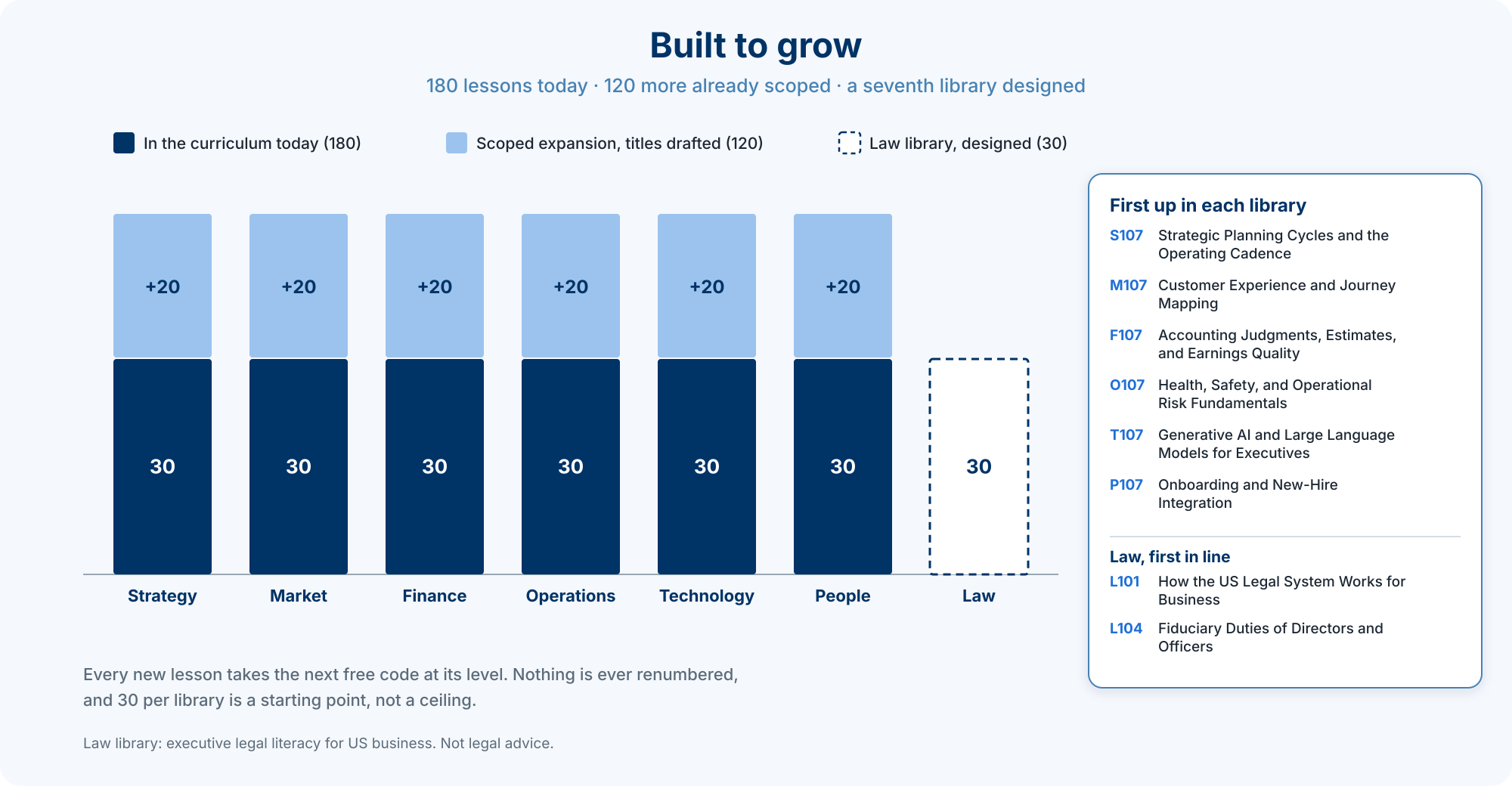
More lessons are coming. 330 lessons are mapped: the 180 available today, 120 more already scoped with titles, and 30 for a seventh library on executive legal literacy for US business. New lessons slot in without renumbering anything you already use.
Choose the license that fits your work.
Enterprise · From $25,000 a year
For departments and whole organizations: ground your AI and every internal agent in the same authoritative source, train each team on its matching libraries, and give everyone one shared foundation.
Practice · From $9,500 a year
For coaches, consultancies and fractional firms using the curriculum with clients.
Personal · $2,500 one-time
For one executive using the curriculum with their AI. Updates at $500 a year. Your purchase is credited in full toward Executive Mentor.
Platform · Let’s talk
For AI and education companies incorporating the curriculum into a product.
Sample the quality, or discuss a license →
Want the environment set up for you?
Executive Mentor brings the same six knowledge libraries into your Microsoft 365 tenant, adds Initiative and Research libraries for your actual situations and trusted outside evidence, and provides configured advisors to help reason across them.
The Executive Curriculum is an independent curriculum by Jack Frost Design. It is not affiliated with or endorsed by any business school.
Judge the quality for yourself.
Request five complete lessons, from a 100-level foundation to a graduate-level capstone, drawn from four of the six libraries, so you can judge the quality of the full curriculum.
The lessons come with a short guide to what to look for: how each lesson is written for people and built for AI, and how one topic deepens from the 100 level to the 300 level. You also get a worked example from Microsoft 365 Copilot, answering the same question with and without the lessons, and the catalog of all 180 lessons.
Tell us where to send your sample. You can also ask about a license or having Executive Mentor set up for you.